
Charles City County Warrant Searches
Virginia’s Online Case Information System, or OCIS, is the public starting point for adult criminal and traffic case information. It includes Charles City General District cases, selected Circuit Court information, and limited Juvenile and Domestic Relations results. It is a case search, not an active-warrant list. Begin with the name as it appears on a citation or court paper, then narrow the result by court and case details.
Keep a case number or hearing date close if one appears on a notice. A similar name can point to someone else, so compare the court, charge, offense date, and hearing information before calling. Ask the issuing court for current status. An online result can lag a new entry, service, recall, or other update.
- Open Virginia OCIS and accept its public-use notice before searching.
- Search the exact name first; the help page also permits partial names of at least two characters.
- Choose Charles City General District, Circuit, or J&DR information that fits the case.
- Use the clerk, magistrate, or Sheriff’s Office to ask what current process can be confirmed.
- If the matter may be federal, use the Eastern District of Virginia route described on the federal court’s official site.
Virginia OCIS Is Not a Live Warrant Ledger
The Virginia OCIS landing page links to adult court information after an acknowledgement step. Use it to locate a docket and note the court and case number. The system does not provide the public with the law-enforcement-only VCIN, NCIC, or NLETS data used to coordinate process.
For a Charles City County question, the online result is one part of a check. A clerk can explain the court file, the magistrate can address issuance or bail questions, and the Sheriff’s Office handles local execution routing. No single public screen joins those functions into a real-time status board.
The landing screen shown here is a public case-search starting point.
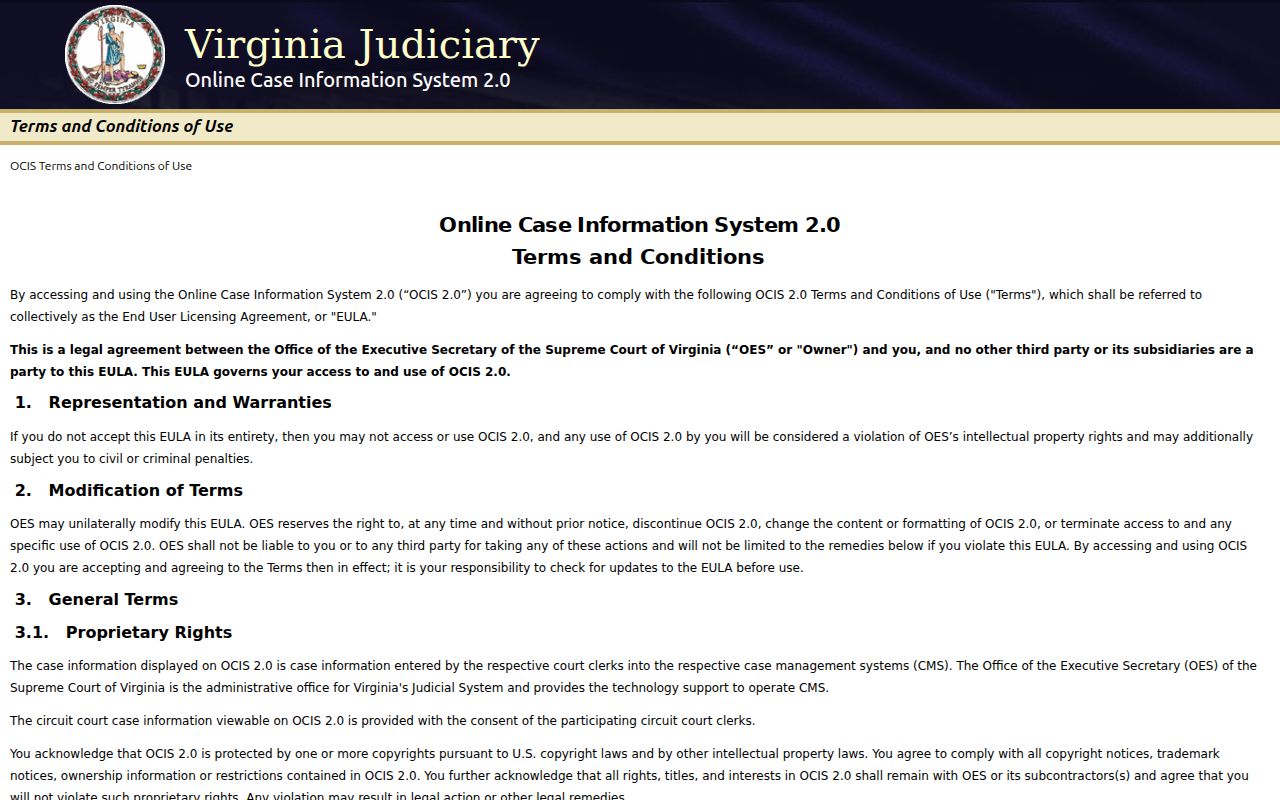
Use the system for case information, then contact a local office when the question is specifically whether process remains active.
Charles City Court Selection Changes a Search
The General District Court search asks the user to select a specific court. Its interface supports name, case-number, and hearing-date searches; a case-number search requires one court instead of “All Courts.” This choice matters when following a Charles City traffic or misdemeanor case.
For a traffic citation, start with the court printed on the ticket and use the citation or case number exactly as shown. For a Circuit criminal file, switch to the Circuit court record rather than assuming a General District result includes felony-trial activity. If the notice names another jurisdiction, searching Charles City alone will not answer that other court’s question.
See the official General District Court selector to confirm the court choice. The selector is part of the search itself.
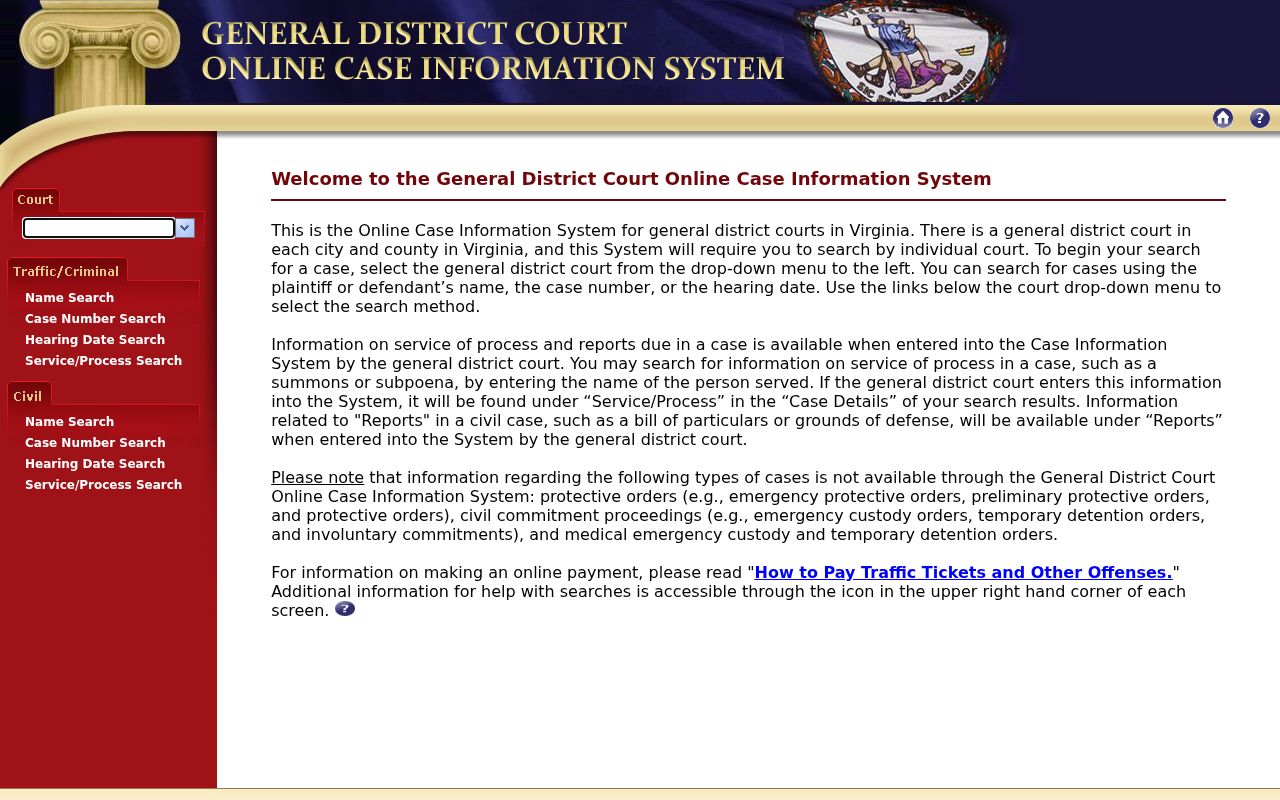
For a separate court-level search, begin again with the right court rather than reusing a number in a different court’s system.
What a Warrant Search Asks For
OCIS separates search choices by name, case number, or hearing date. Court level and a particular court can narrow the results. The official OCIS search help describes the available fields and controls; it does not publish a Charles City warrant-number format or a single required-field checklist.
Use a full name first and a partial spelling only when needed. Search by hearing date, not an assumed issue date. Execution or recall details may be absent or delayed.
The official help screen documents the search controls but does not show a Charles City case.
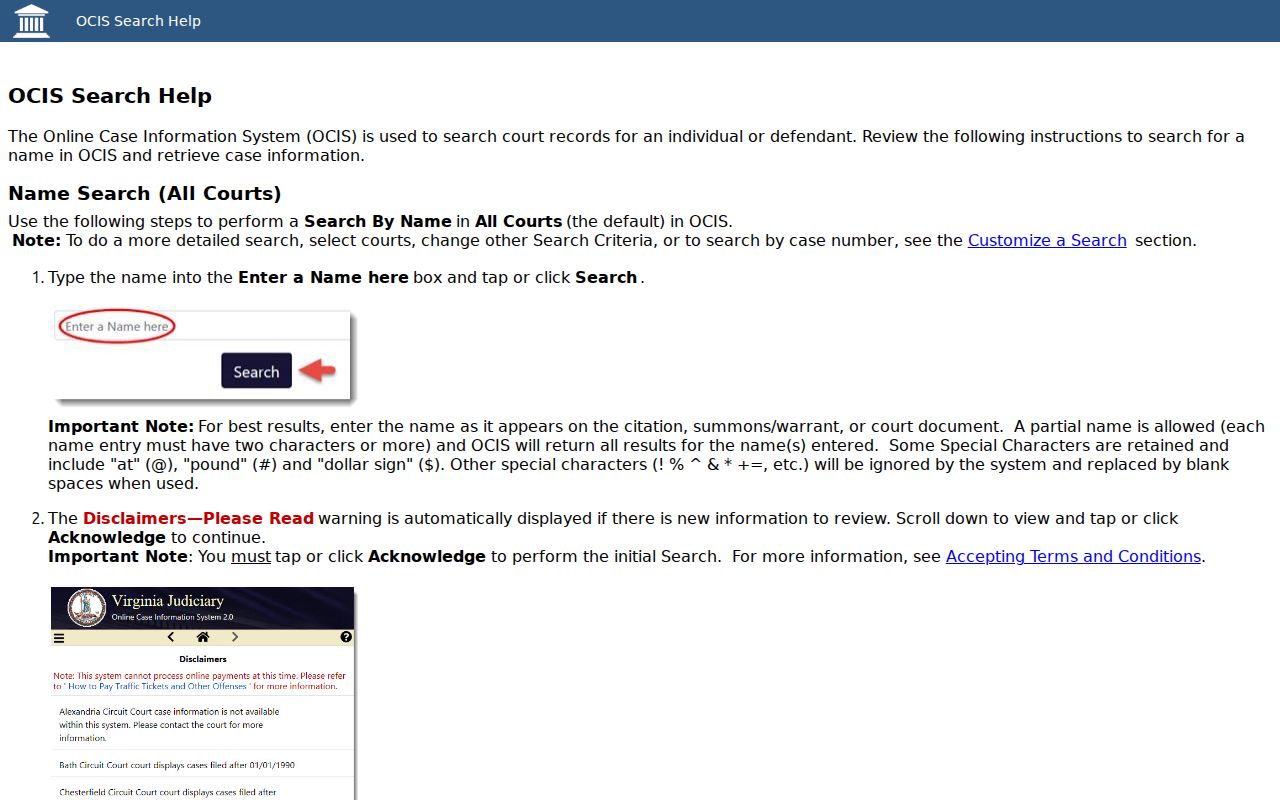
Use the instructions to navigate the search, then ask the clerk for the public record.
| Field Label | Type | Required | Notes |
|---|---|---|---|
| Name | Text | Search choice | Use the spelling on the citation or court paper; partial entries need at least two characters. |
| Case number | Text | Search choice | Select one specific General District Court before searching by number. |
| Hearing date | Date | Search choice | Time and court filters may narrow a hearing search. |
| Court level | Filter | Optional filter | Options cover Circuit, General District, and J&DR information within system limits. |
| Court | Selection | Required for case number | Choose the court that matches the case record. |
Charles City County Warrant Search Results
A match in the public court system is a docket result. It may help identify which clerk holds a file, but it does not make OCIS an official record or a live warrant roster. Read the court, case number, charge, and dates together. Service and disposition details may appear only when entered and may vary by proceeding.
Compare same-name candidates by court, case number, charge, and offense date. Ask the issuing clerk whether process was recalled.
| Court | Identifies the court whose docket is being viewed. |
|---|---|
| Case number | Lets the clerk locate the same file when asked about process. |
| Charge and code | Shows the listed offense and code section, not the case outcome by itself. |
| Offense date | Records the date attached to the charge; it is distinct from issue or service dates. |
| Hearing date | Shows a scheduled appearance when that information is available. |
| Service or disposition | May appear in details, but neither field guarantees current execution status. |
A Clerk, Magistrate, and Sheriff Have Separate Roles
The Combined District Courts clerk keeps General District and J&DR case information; the Circuit Clerk handles circuit files. The magistrate reviews complaints and handles probable-cause and bail work. The Sheriff’s Office executes court process. These roles explain why a case search, a clerk call, and a sheriff inquiry may produce different pieces of an answer.
Combined District Court Clerk
General District and J&DR records
804-652-2188
Charles City Magistrate Office
Complaint, warrant, and bail routing
804-652-2478
For a circuit felony file, call the Circuit criminal division rather than assuming the combined clerk holds it.
Charles City County Warrants: Who Holds What
Charles City County has no municipal court or incorporated-town court. General District handles most local traffic and misdemeanor cases, J&DR has separate family and juvenile matters, and Circuit Court handles felony trials and circuit process. A magistrate may issue a warrant, while a clerk maintains the case file and the Sheriff’s Office serves process.
Virginia has no public statewide active-warrant repository. State law-enforcement systems such as VCIN, NCIC, and NLETS are not public search tools. For an out-of-county or state-level question, use the relevant issuing court or law-enforcement office rather than expecting one site to cover all jurisdictions.
Charles City FOIA Requests Seek Existing Records
County administrative records go to the county FOIA officer, while court case records go to the appropriate clerk. The county accepts requests by email, mail, fax, phone, or in person and aims to respond within five working days, with a permitted written extension. It may charge actual staff time, copying, and postage, and can ask for an estimate or deposit.
A narrow request can ask whether an existing aggregate report or written procedure is held. FOIA does not require staff to create a new warrant list, answer a legal question, or disclose material protected by criminal-investigation, juvenile, sealed-record, or other exemptions.
The county’s FOIA request page gives the current process and form. It is not a substitute for asking the Circuit or Combined District Courts clerk about a case file.
A Blank Search Can Reflect Timing or Access Limits
OCIS may not yet contain a new case, may omit a restricted record, or may show only a docket event rather than an easy-to-read warrant field. Juvenile, domestic, sealed, expunged, and investigative information has separate limits. The public cannot see the law-enforcement systems used by officers.
Record the court and case number from a result, then ask that clerk what public confirmation is available. If nothing appears, contact the office tied to the matter rather than treating the blank page as proof that no process exists.
Key point: a public case search can help locate a file, but the issuing court or sheriff must answer a current-process question.
Which Warrants Stay Restricted
Virginia’s Freedom of Information Act applies to county administrative records, but a county FOIA request is not automatically a request for a judicial case file. Court records are handled through the clerk and remain subject to statutes, court orders, and case-specific limits. Investigative files may be withheld or redacted, and juvenile law-enforcement records have distinct confidentiality rules.
Key Rules:
Virginia Code §2.2-3706.1 permits protection for criminal investigative files.
Virginia Code §16.1-301 limits public access to juvenile law-enforcement records.
A sealed or unentered record may not appear in a public search; a clerk or attorney can explain the proper route for a specific matter.